
Interpretable Data-Driven CFD Modeling via Field Inversion & Symbolic Regression
🔍 Project Overview
Machine-learned corrections in CFD are often black boxes that are expensive to run and hard to carry over to other solvers. This project uses a two-step field inversion (FI) → symbolic regression (SR) approach to obtain explicit, closed-form models:
- Field inversion finds the cell-wise correction that best matches high-fidelity or experimental reference data.
- Symbolic regression turns that correction into a compact algebraic expression of local flow features.
The resulting models are interpretable, cheap to evaluate, and simple to implement in other solvers.
📚 Applications
1. Mechanism-Separated Closed-Form Transition Model (Under Review, AIAA Journal)
- Separate correction branches for natural, crossflow, and separation-induced transition, added to the Spalart–Allmaras production term.
- No additional transport equations and no neural-network inference.
- Tested on canonical cases, a natural-laminar-flow transport wing, and a hovering rotor; on the rotor it needed about 55% of the wall-clock time of a comparable transport-equation model.
- 📄 Publication page · arXiv:2609.24162
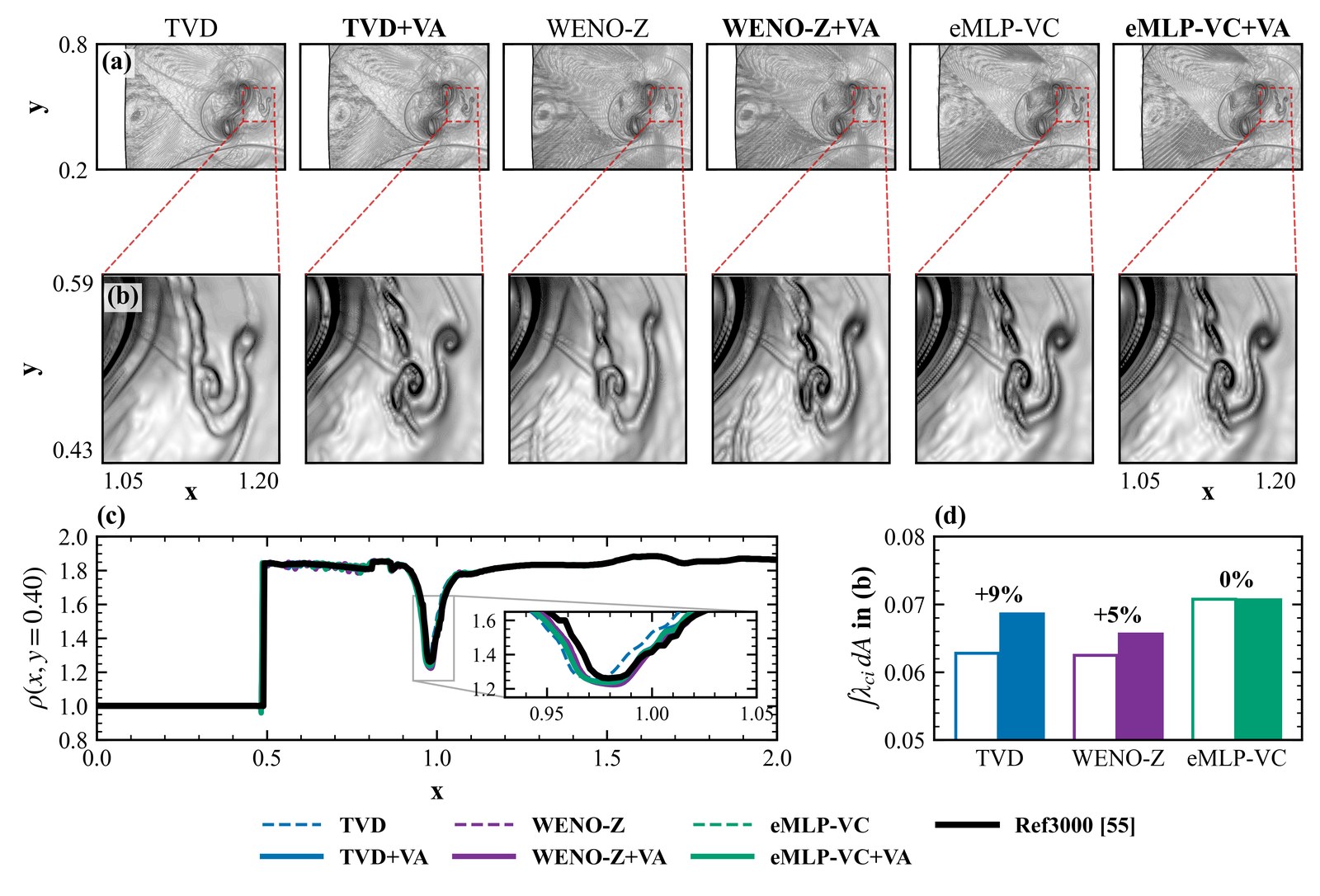
2. Vortex-Aware Reconstruction Selection (Under Review, JCP)
- Reduces the numerical dissipation of under-resolved vortices in compressible flows.
- Works as an add-on to TVD, WENO-Z, and eMLP-VC reconstructions while keeping their shock-capturing behavior.
- Demonstrated on vortex transport, Taylor–Green vortices, shock–vortex interaction, shock–wedge diffraction, and blade–vortex interaction.
- 📄 Publication page with numerical examples
🧪 Technical Skills Demonstrated
- Methods: Field inversion, symbolic regression, adjoint-based optimization, RANS transition modeling, shock-capturing reconstruction (TVD, WENO-Z, MLP)
- Applications: Laminar-to-turbulent transition, vortex-dominated compressible flows, rotor aerodynamics