Vortex-Aware Reconstruction Selection for Reducing Vortex Dissipation, Informed by Field Inversion and Symbolic Regression

Published in Journal of Computational Physics (JCP), 2026

📝 Status: Under review (Journal of Computational Physics). Since the manuscript is not yet published, the formulation is omitted here; this page shows selected numerical examples only.

🔍 Overview

Vortices in compressible flows often travel long distances on grids that resolve their cores with only a few cells. Shock-capturing reconstructions tend to treat such under-resolved vortices as discontinuities, and the extra dissipation weakens them over time.

This work proposes a vortex-aware (VA) reconstruction selector, informed by field inversion and symbolic regression, that keeps vortices from decaying while leaving the baseline’s shock capturing unchanged. VA works as an add-on to three different baseline reconstructions: TVD, WENO-Z, and eMLP-VC.

âś… Highlights

  • Better preservation of vortex circulation and vortical structures for all three baselines.
  • Shock and shear-layer behavior of the baselines is kept.
  • Small additional computational cost.

đź§Ş Numerical Examples

Linear-wave advection
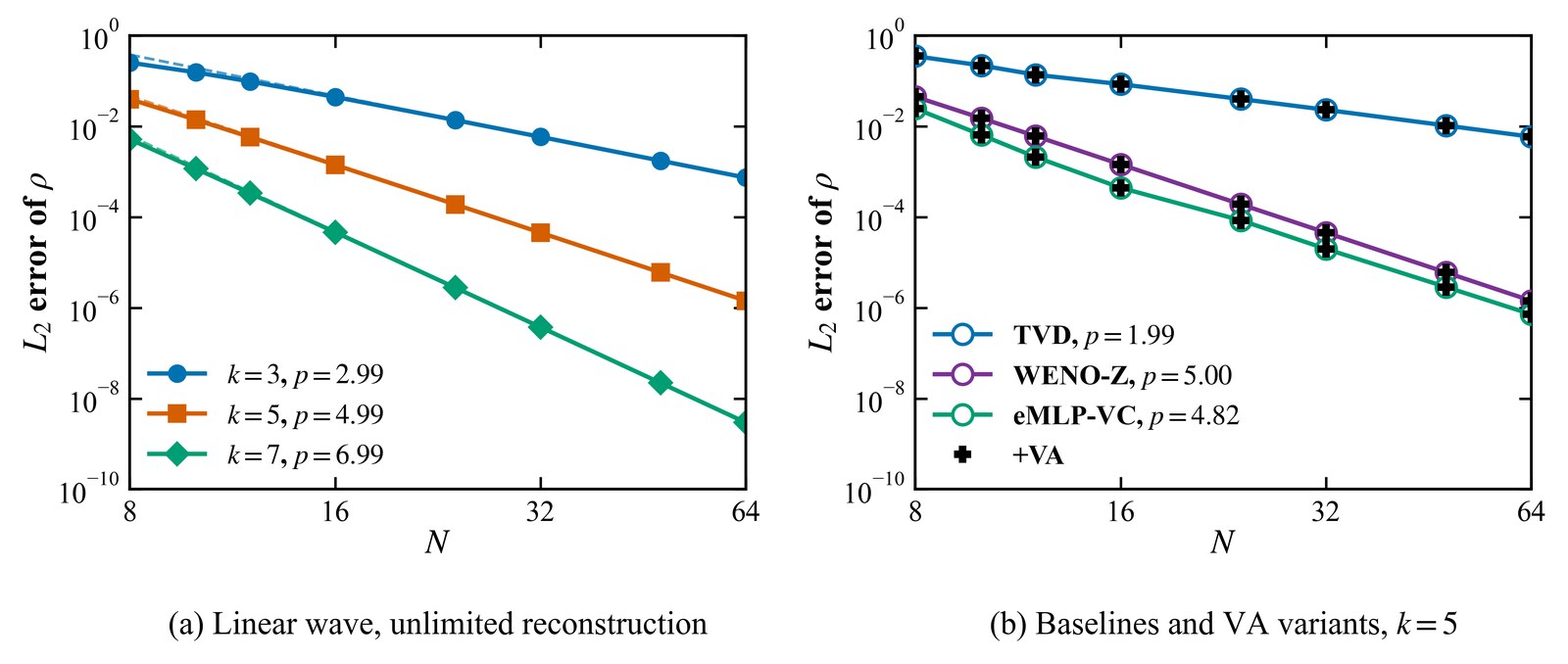
Linear-wave advection grid convergence
Grid convergence for linear-wave advection: the baselines and their VA variants keep the design order of accuracy.

Isentropic vortex on an under-resolved grid
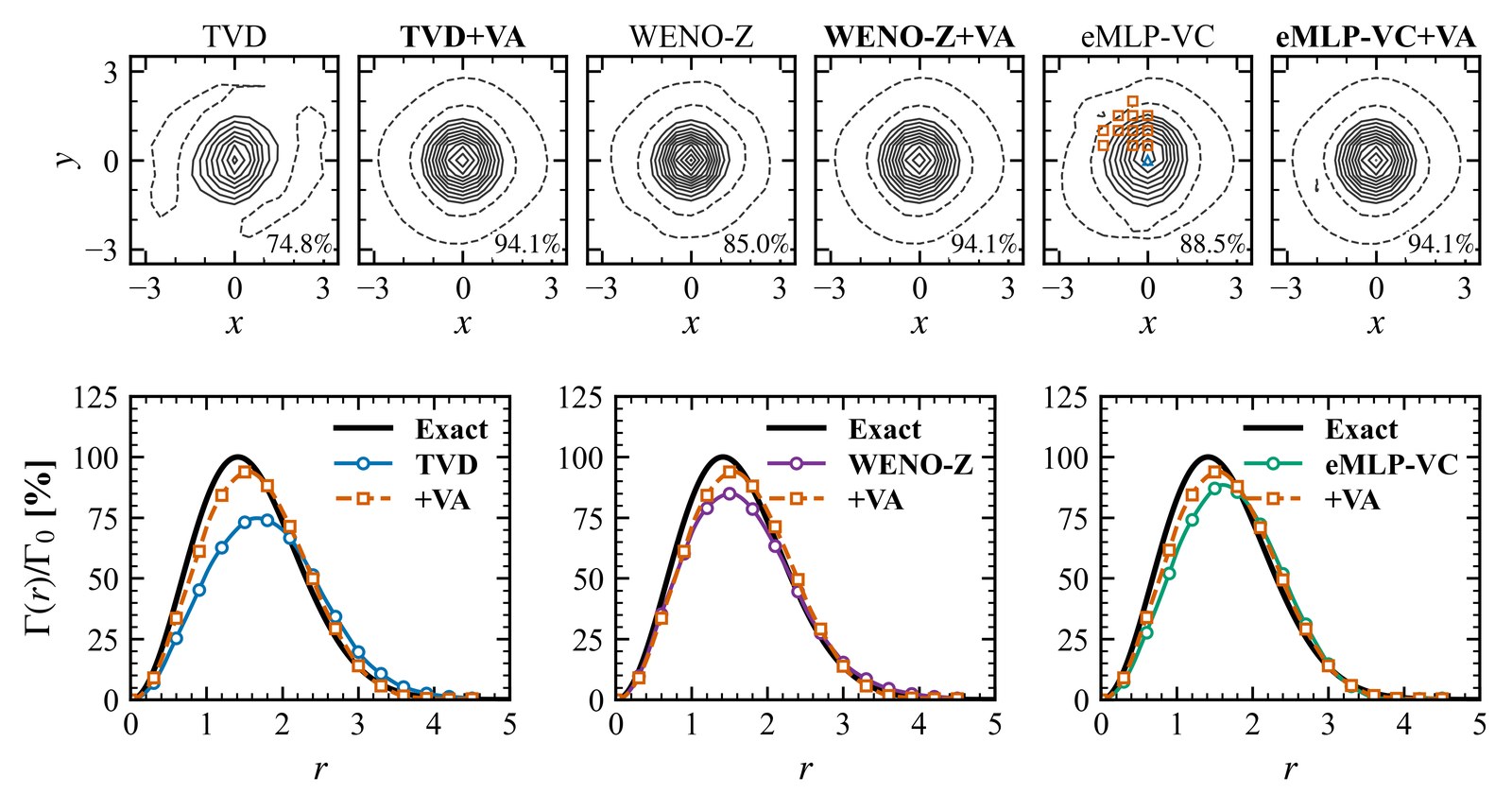
Isentropic vortex vorticity and circulation
Vorticity and radial circulation of the isentropic vortex on a 20 Ă— 20 grid. Bold titles denote VA variants.

Taylor–Green vortex (subsonic and supersonic)
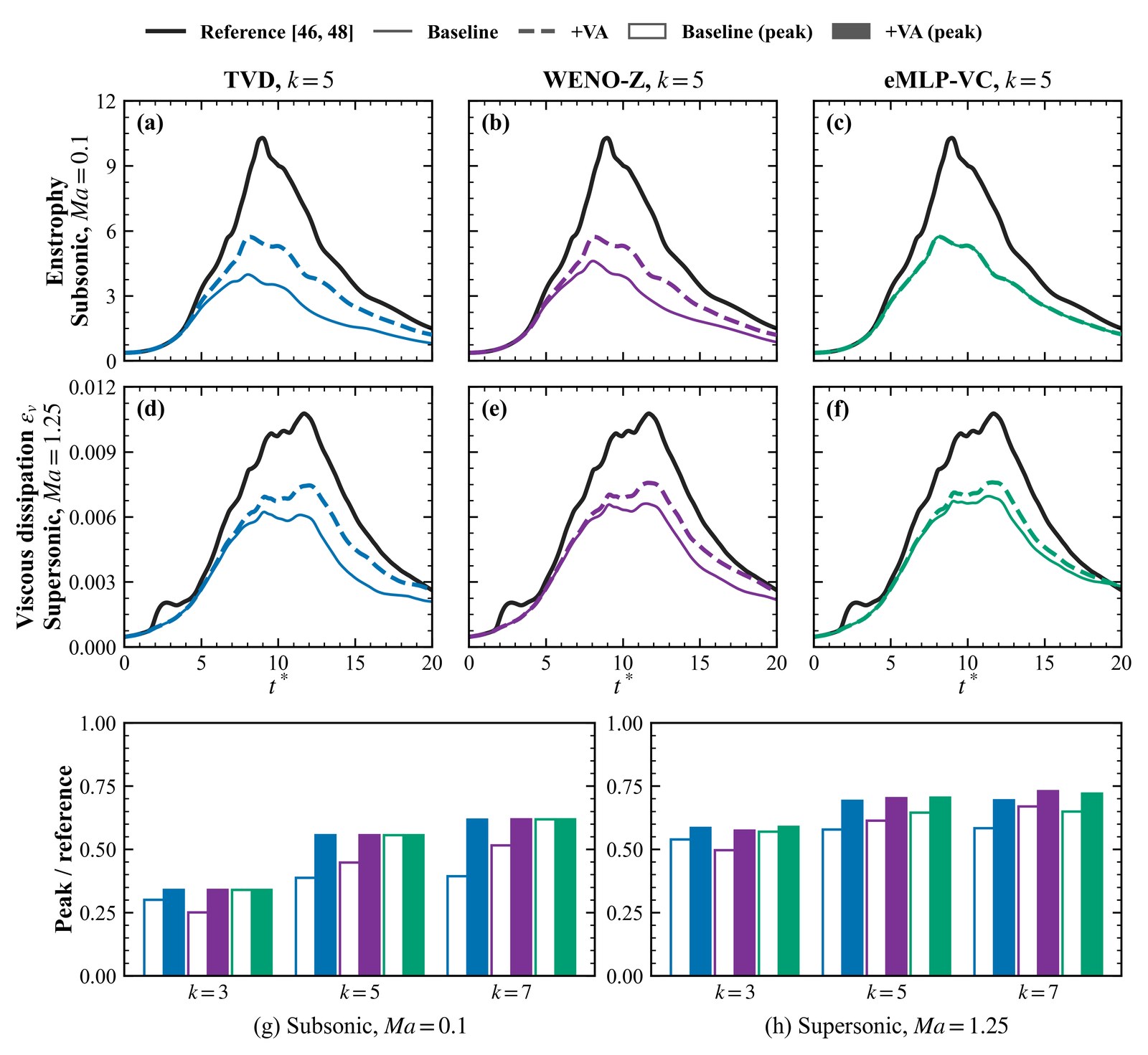
Taylor-Green vortex enstrophy and dissipation history
Taylor–Green vortex on 128³: enstrophy at Ma = 0.1 and viscous dissipation rate at Ma = 1.25.
Subsonic Taylor-Green vortex Q isosurfaces
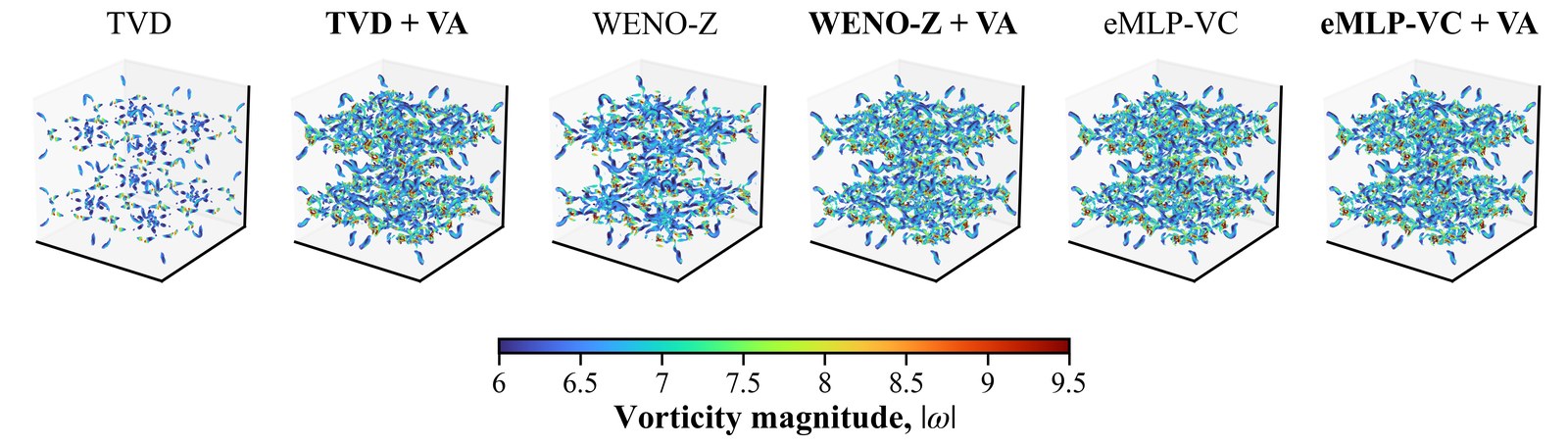
Q-criterion isosurfaces of the subsonic Taylor–Green vortex (Ma = 0.1), colored by vorticity magnitude.
Supersonic Taylor-Green vortex Q isosurfaces
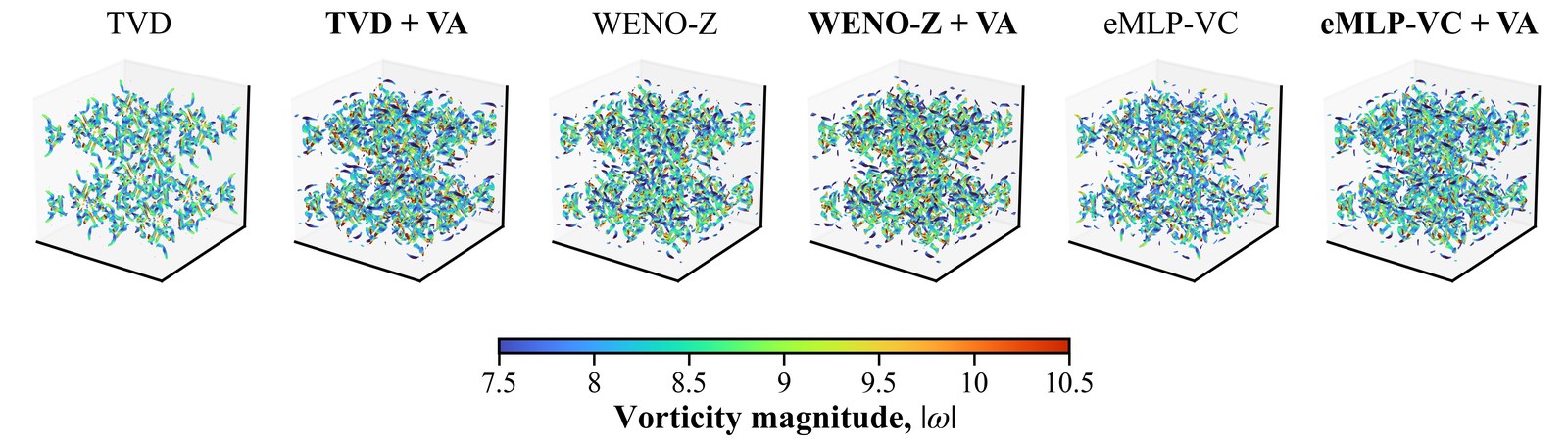
Q-criterion isosurfaces of the supersonic Taylor–Green vortex (Ma = 1.25), colored by vorticity magnitude.

Stationary shock and steady shock reflection
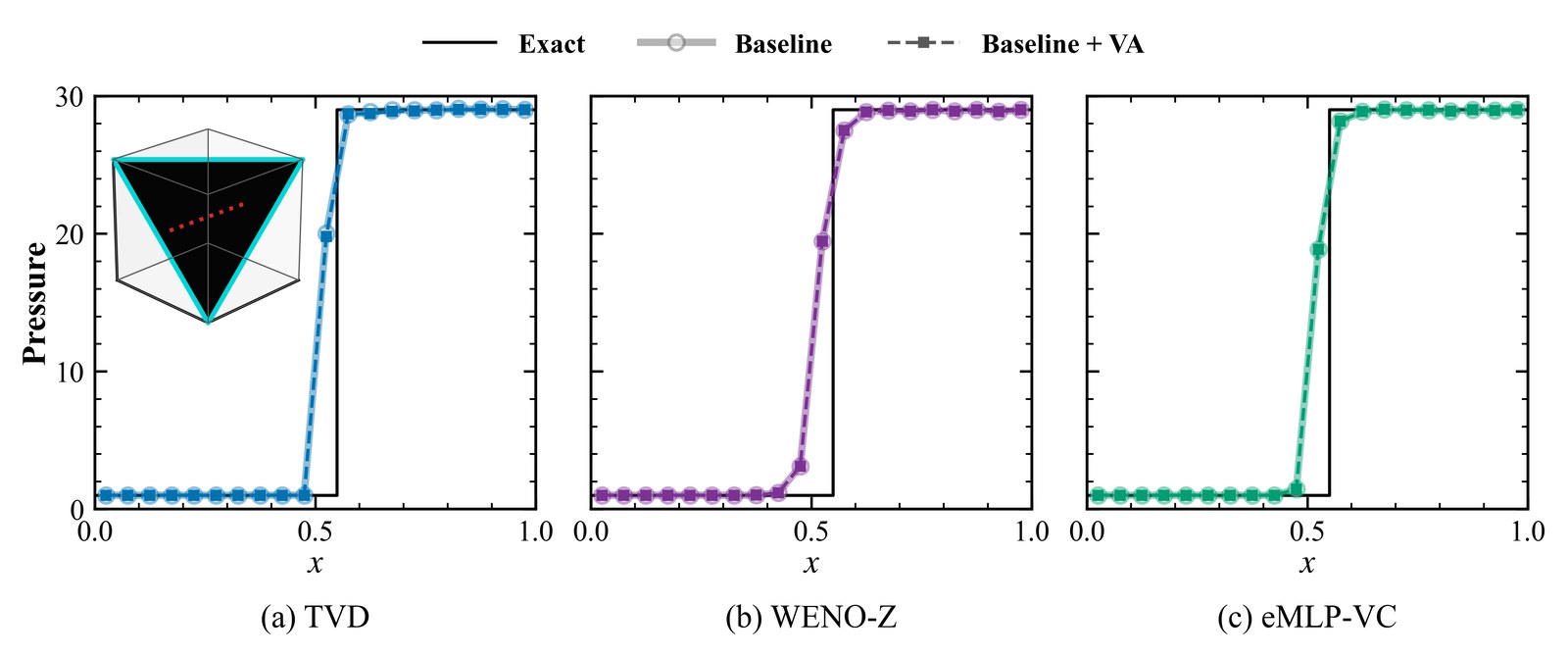
Stationary shock pressure profiles
Pressure along a line through the stationary shock for each baseline and its VA variant.
Steady regular shock reflection convergence
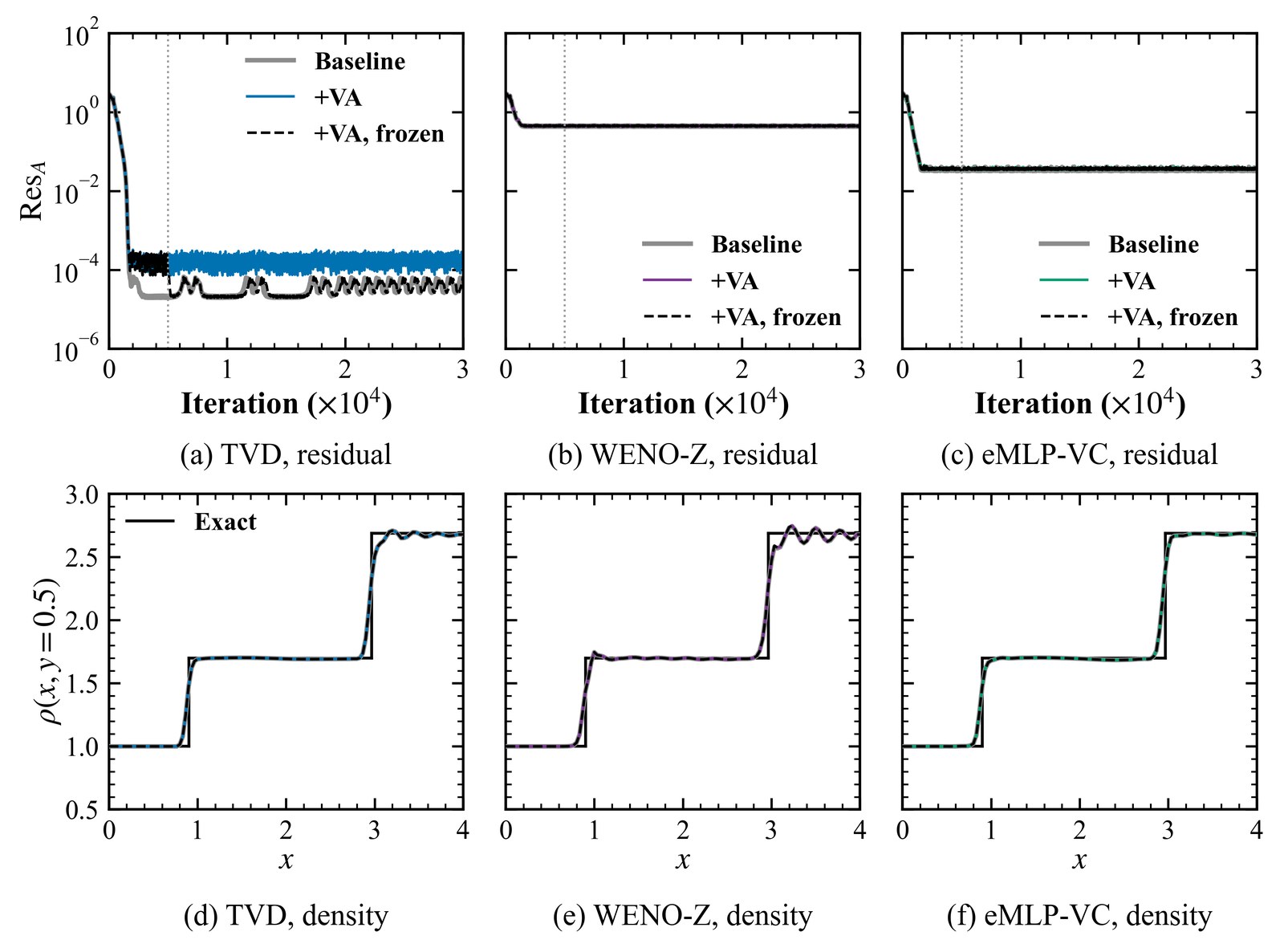
Steady regular shock reflection: residual histories and density profiles.

Kelvin–Helmholtz instability

Kelvin-Helmholtz roll-up vorticity
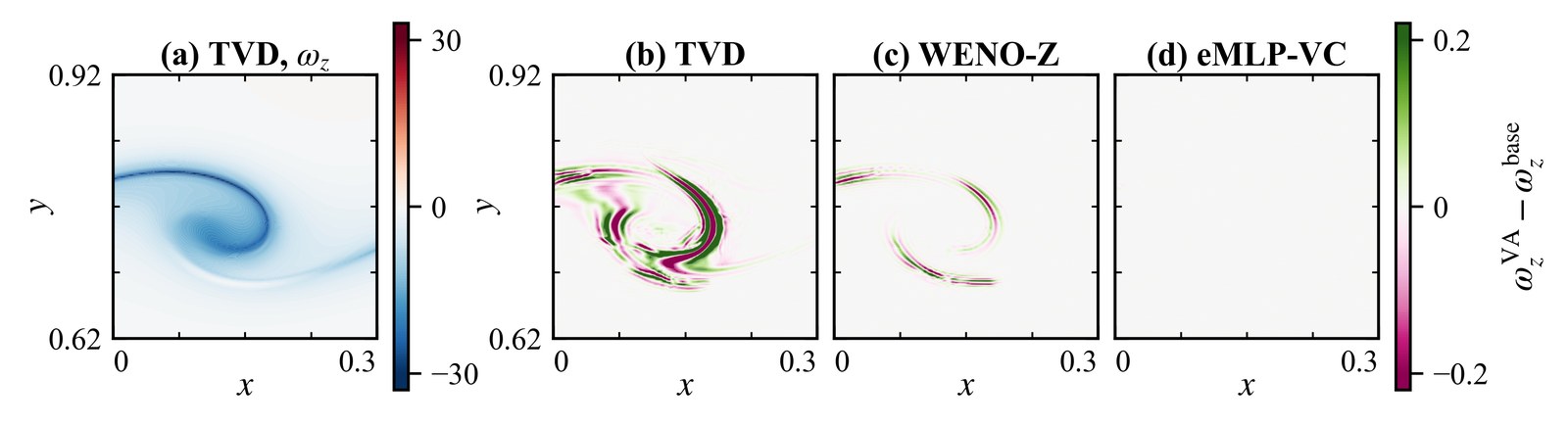
Vorticity in one Kelvin–Helmholtz roll-up and its change due to VA for the three baselines.

Shock–vortex interaction

Shock-vortex interaction numerical schlieren
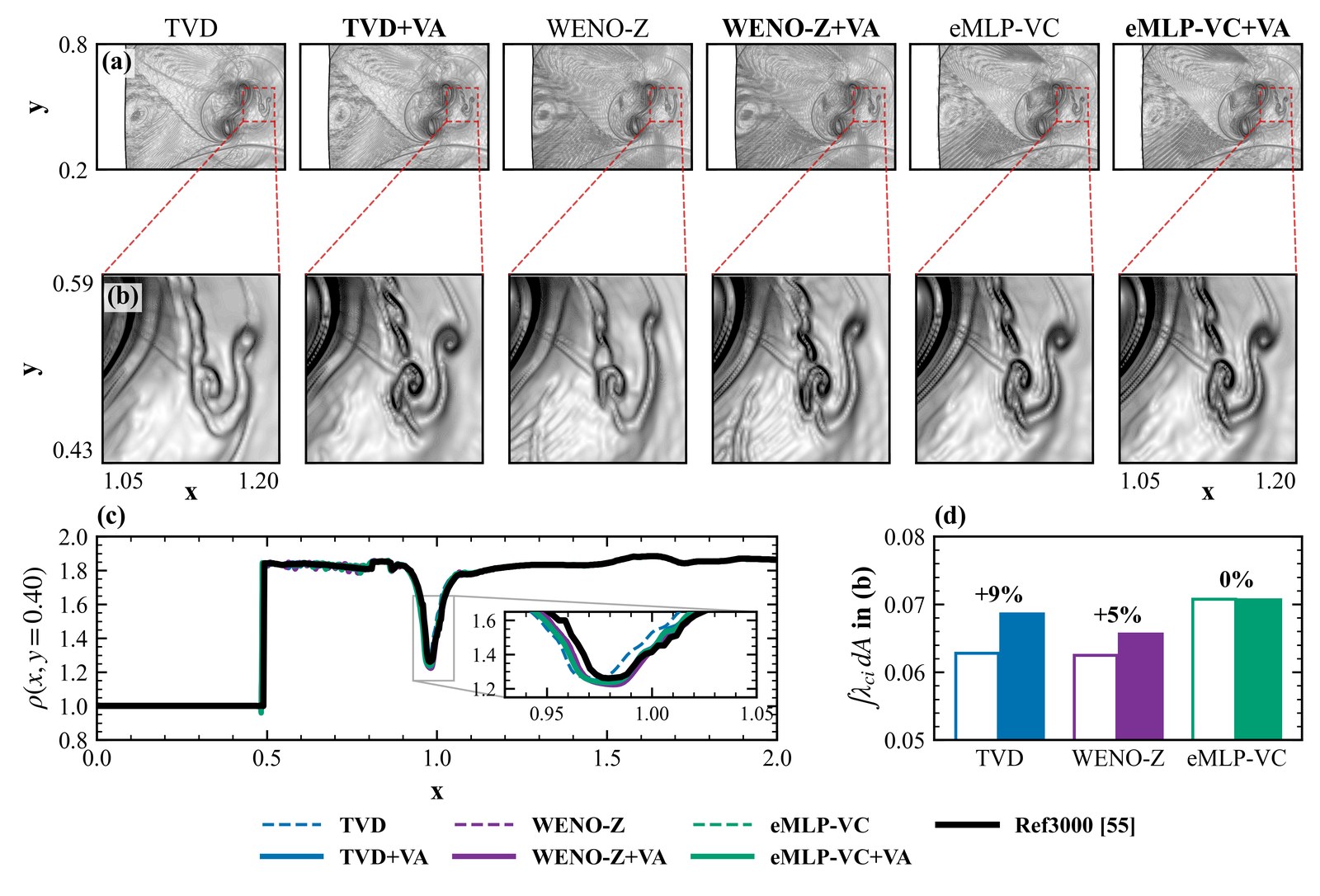
Shock–vortex interaction: numerical schlieren, enlarged tail, and density profile against a fine-grid reference.

Shock–wedge diffraction

Shock-wedge diffraction schlieren and vorticity
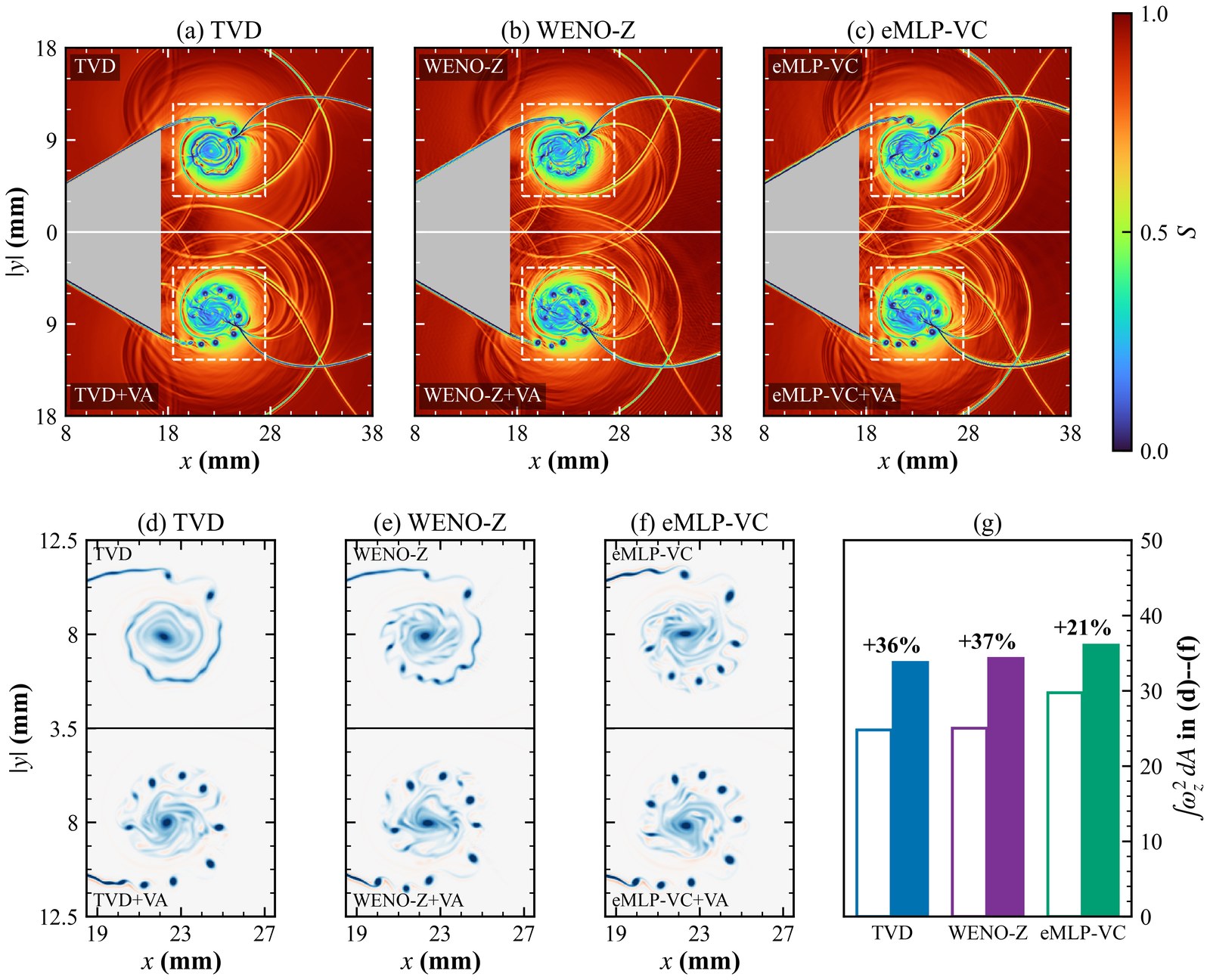
Shock–wedge diffraction: numerical schlieren (baseline above, mirrored VA result below) and vorticity of the shed vortex.

Two-dimensional blade–vortex interaction (BVI)
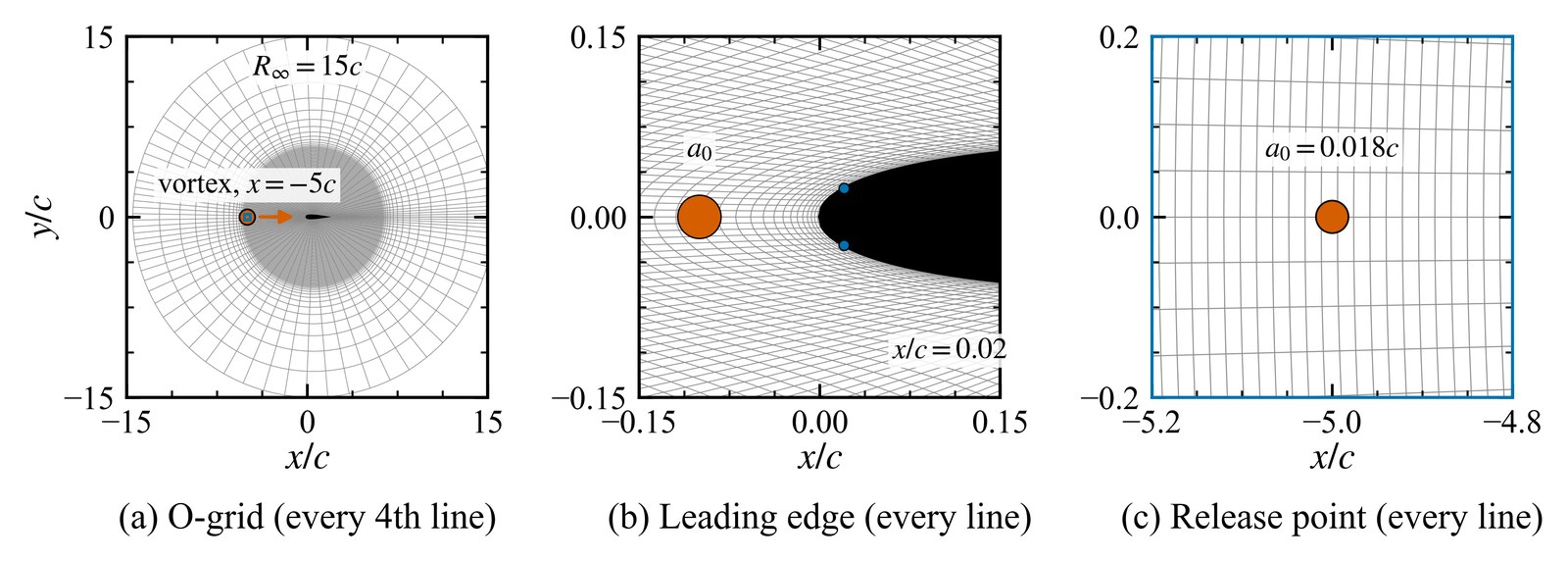
Two-dimensional BVI configuration
Configuration of the two-dimensional blade–vortex interaction: O-grid, leading-edge stations, and vortex release point.
Incoming vortex of the BVI case
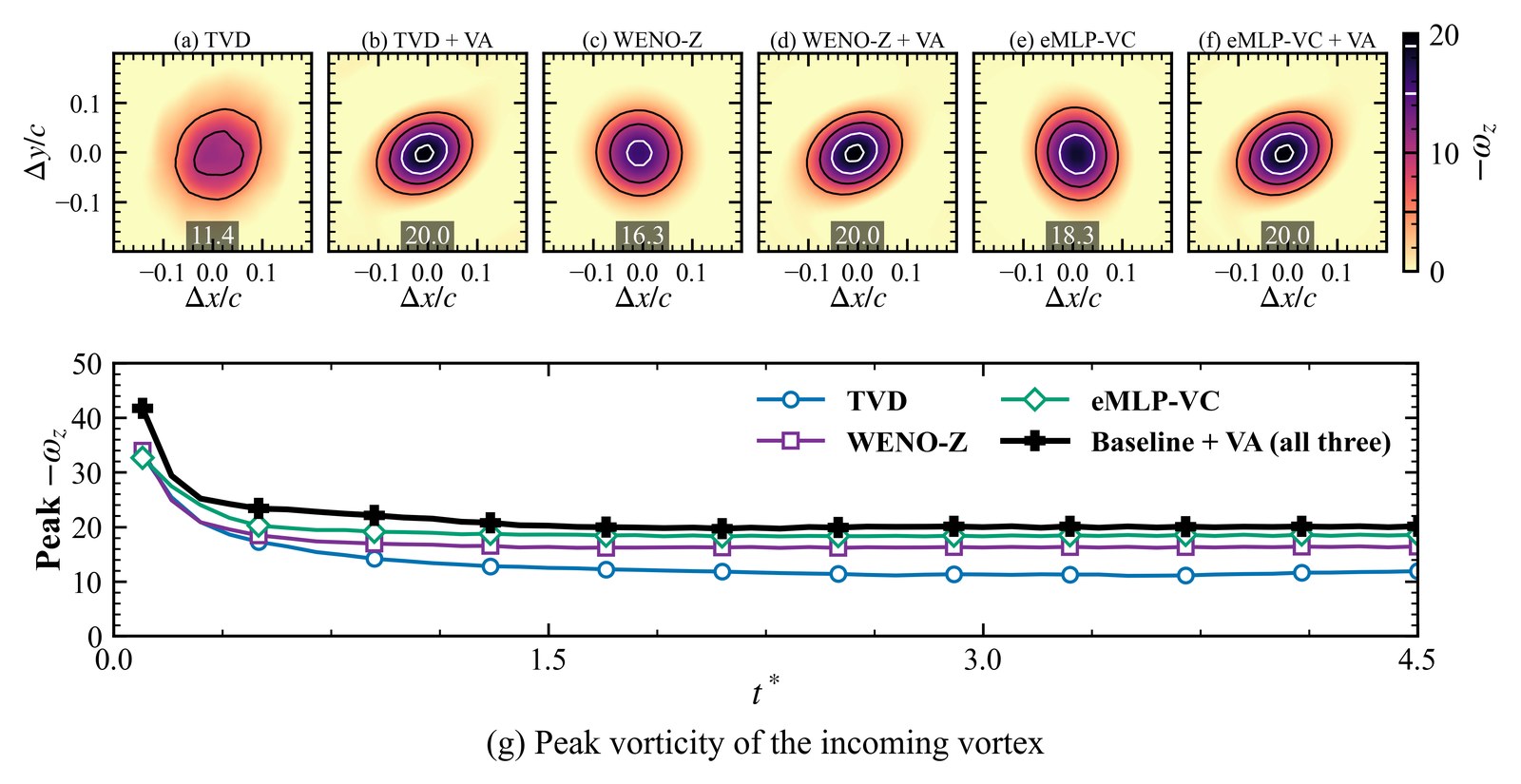
The incoming vortex approaching the airfoil, for each baseline and its VA variant.
BVI surface pressure coefficient history
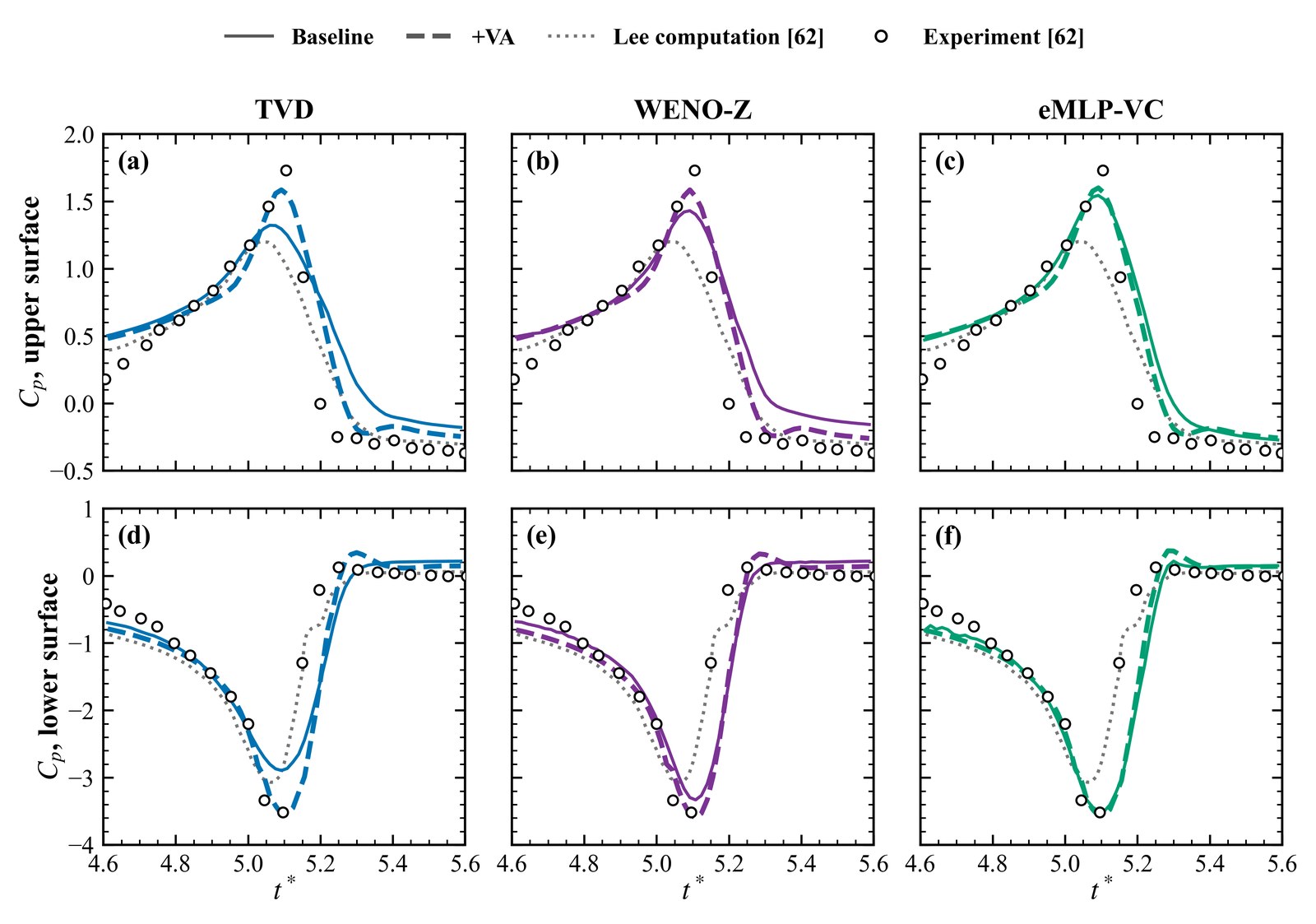
Surface pressure coefficient near the leading edge (x/c = 0.02) during the interaction.

Recommended citation: Seunghyun Joo, Yoonpyo Hong, Younghyo Kim, Kwanjung Yee. (2026). “Vortex-Aware Reconstruction Selection for Reducing Vortex Dissipation, Informed by Field Inversion and Symbolic Regression.” Under review, Journal of Computational Physics.