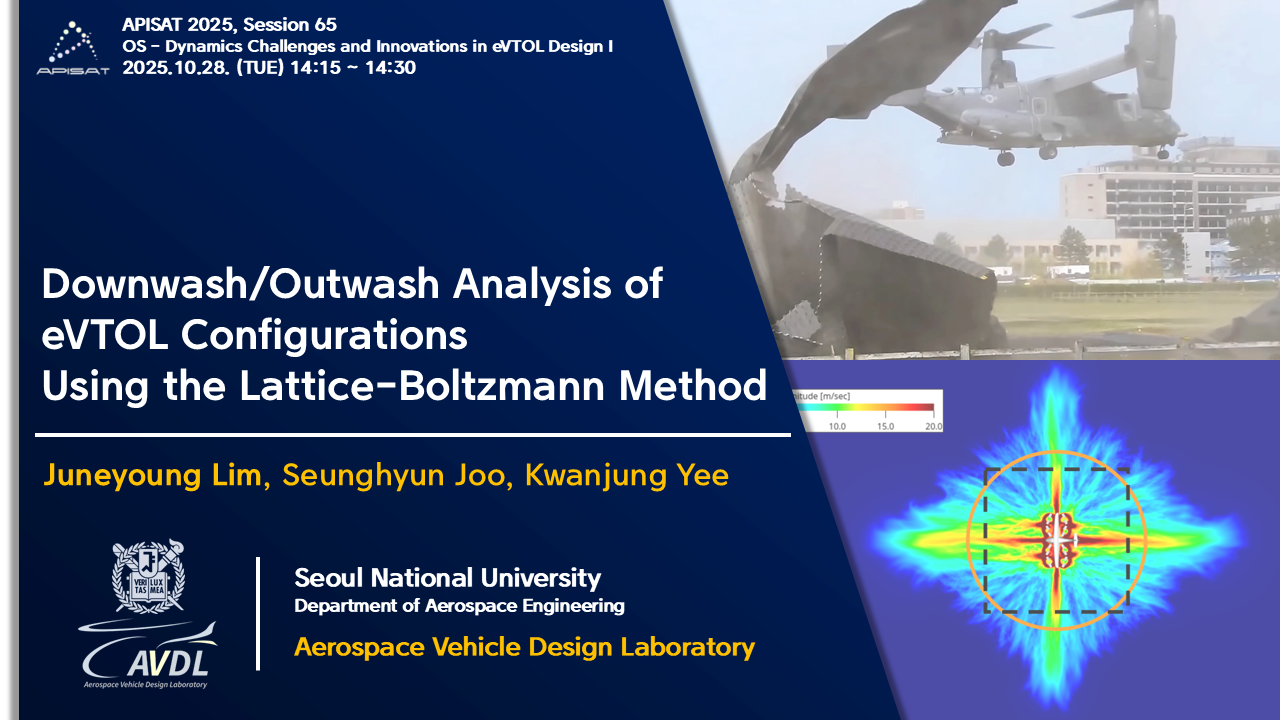
eVTOL Downwash/Outwash Analysis using LBM
🔍 Project Overview
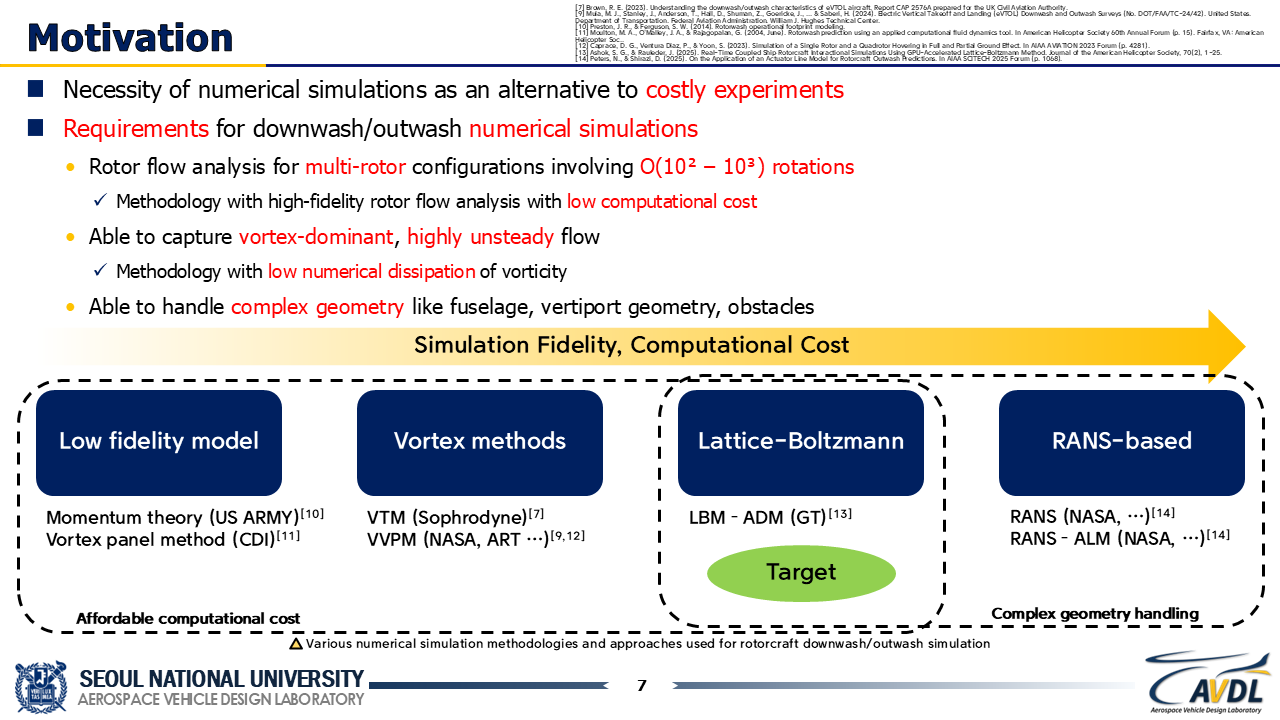
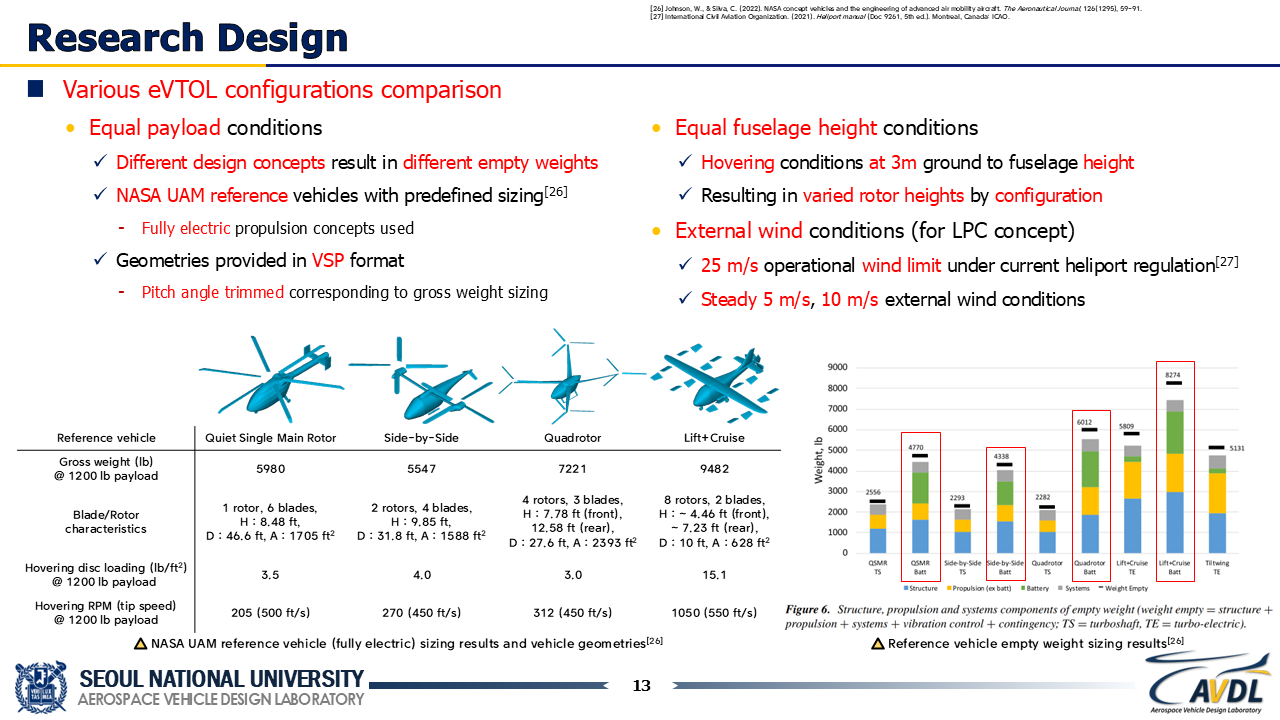
Investigated the complex aerodynamic interference of eVTOL aircraft during hover and near-ground operations to address the limitations of current heliport/vertiport safety regulations.
While current vertiport design standards define a fixed safety area (e.g., 2.5D), recent studies and surveys indicate that these criteria may not sufficiently account for configuration-dependent outwash hazards of multi-rotor eVTOL aircraft.
This research aims to provide a high-fidelity aerodynamic assessment framework to support future regulation evolution.
⚙️ Methodology
Lattice-Boltzmann Method (LBM)
Used SIMULIA PowerFLOW, a commercial LBM-based CFD solver featuring:
- Algebraic governing equations with lattice-level parallelization
- Low numerical dissipation for vortex-dominant rotor flows
- Efficient handling of moving geometries (rotors) via facet-based boundary treatment
LBM was selected to balance:
- High-fidelity unsteady rotor wake prediction
- Affordable computational cost for O(10²–10³) rotor revolutions
- Capability to model complex fuselage and ground geometries
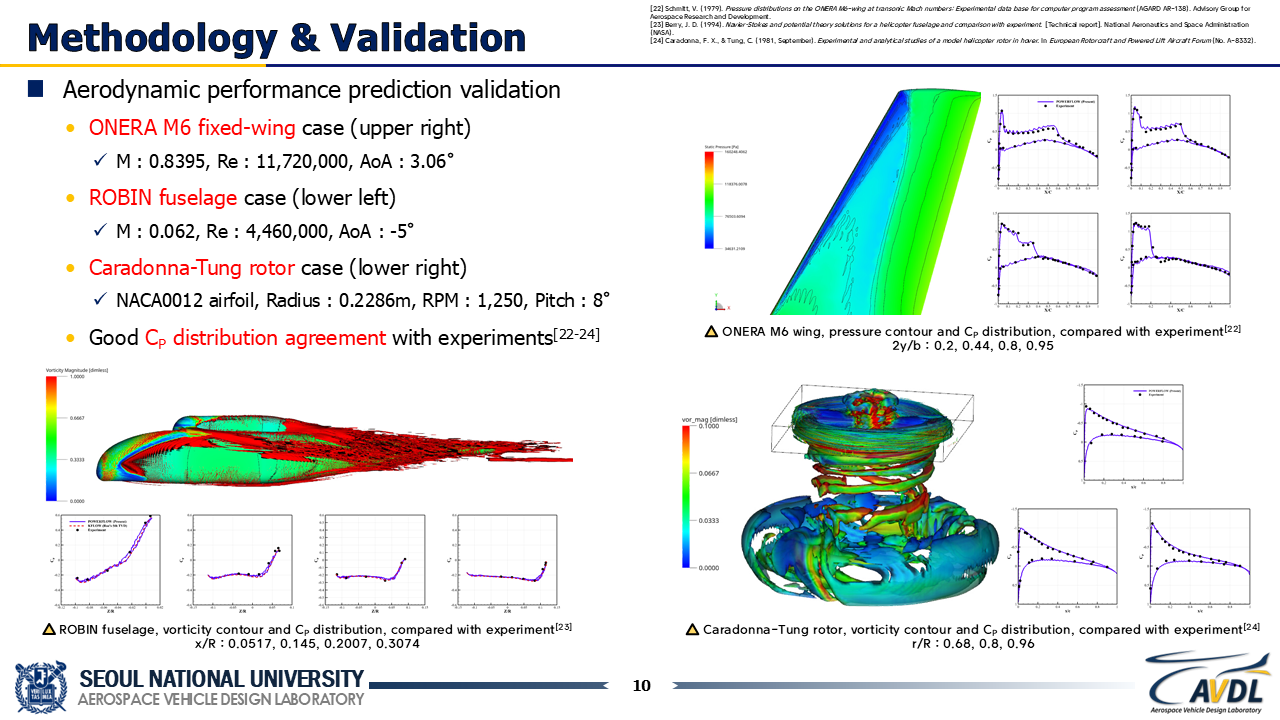
Solver Validation
Validation was performed at two levels:
- Aerodynamic Performance Validation
- ONERA M6 wing
- ROBIN fuselage
- Caradonna-Tung rotor → Good Cp distribution agreement with experiments.
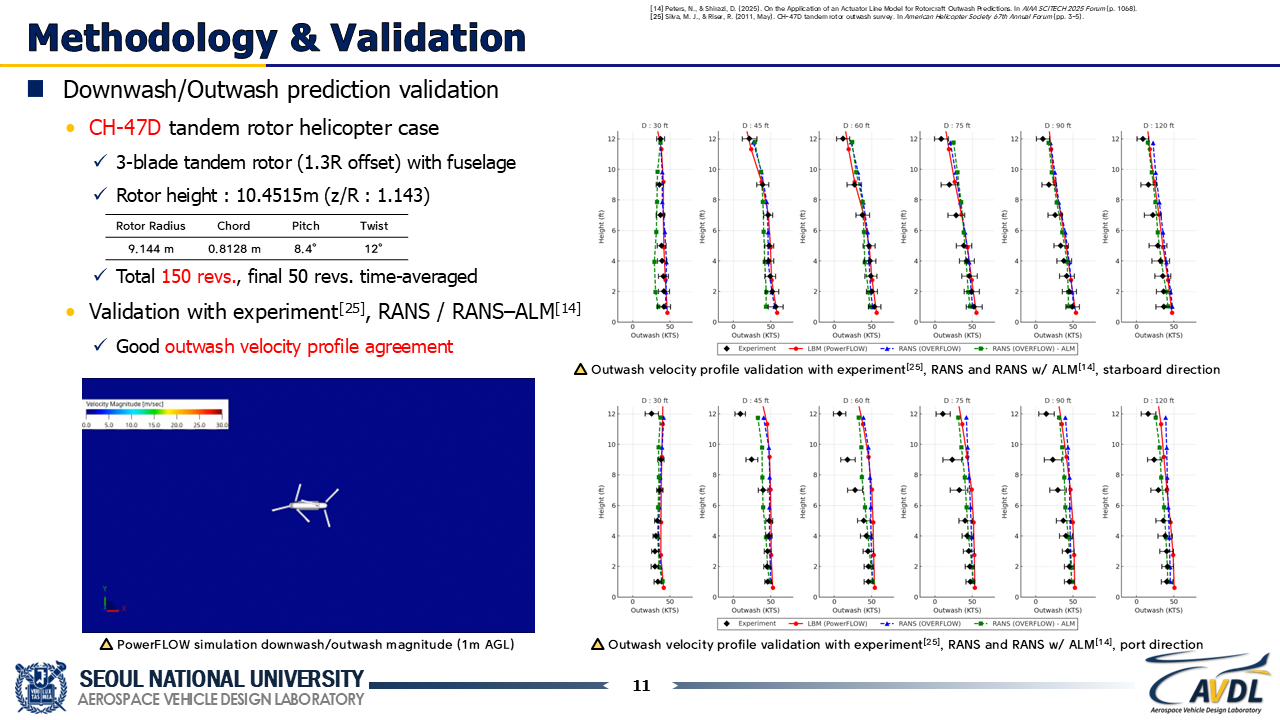
- Downwash/Outwash Validation
- CH-47D tandem rotor helicopter
- Compared against experimental survey data and RANS / RANS-ALM → Accurate prediction of outwash velocity profiles at 1 m AGL
Configuration-Level Physical Insights
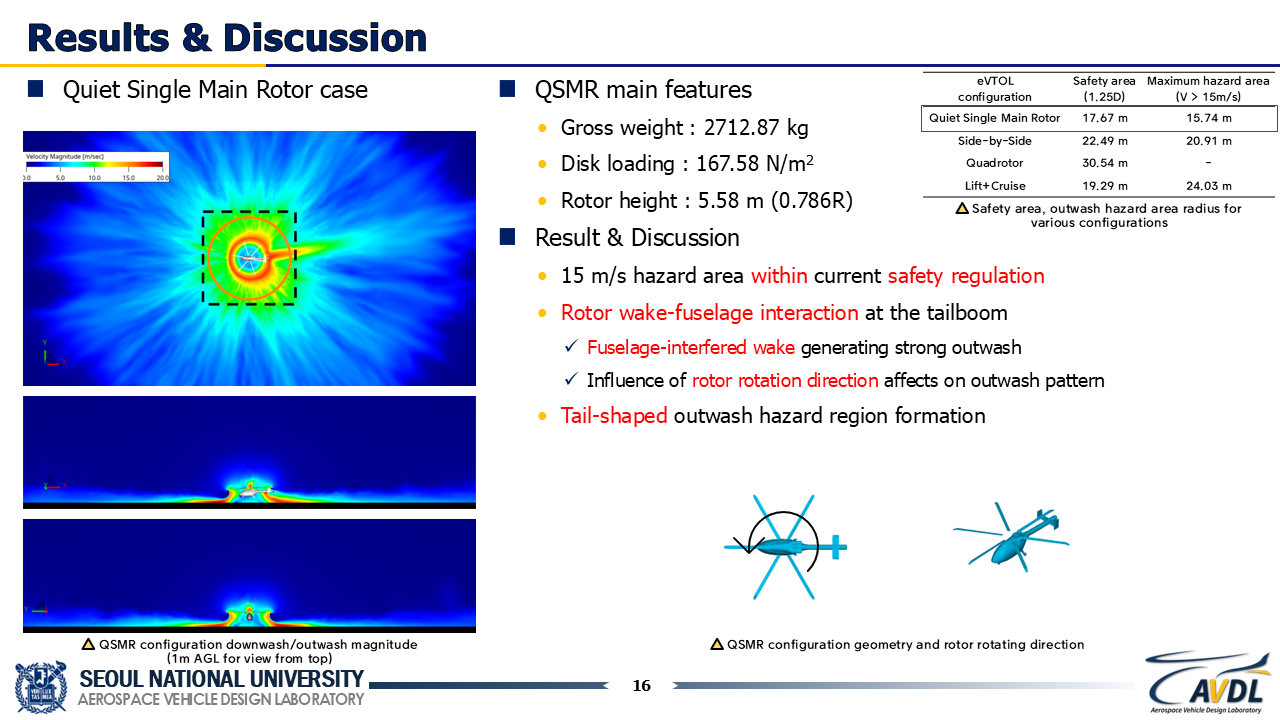
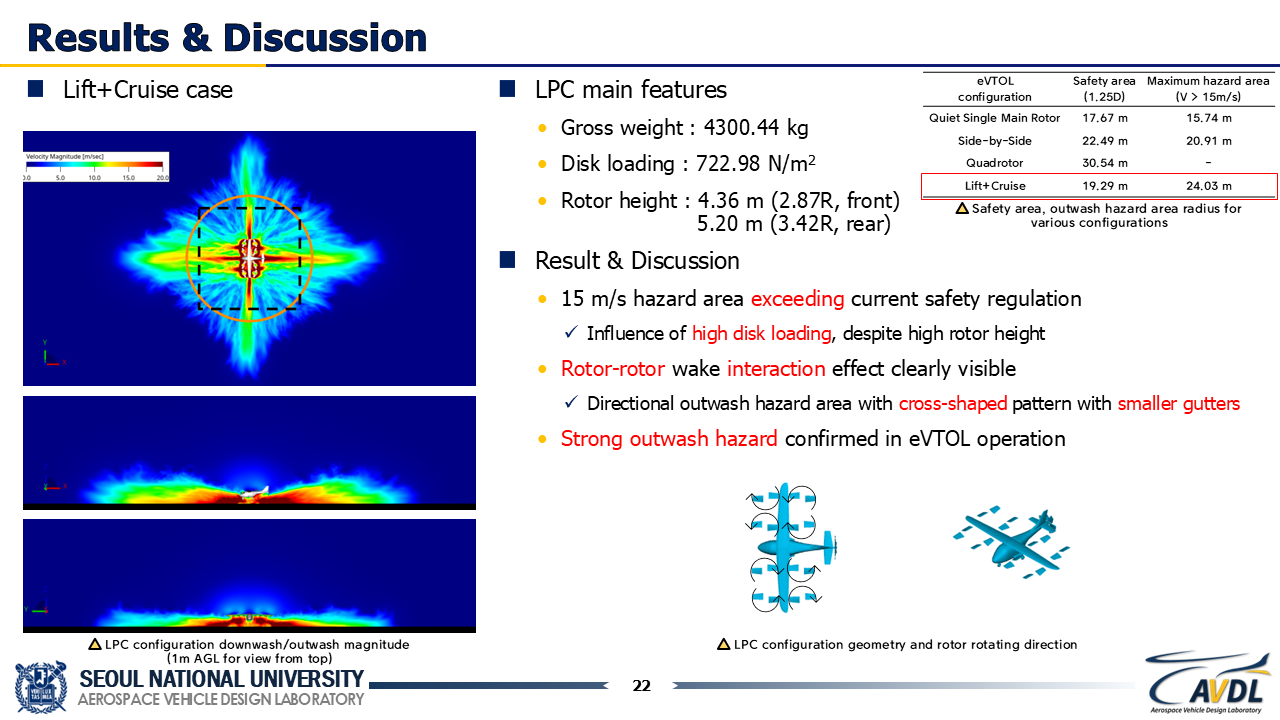
- QSMR: Tailboom–wake interaction produced a tail-shaped outwash hazard region.
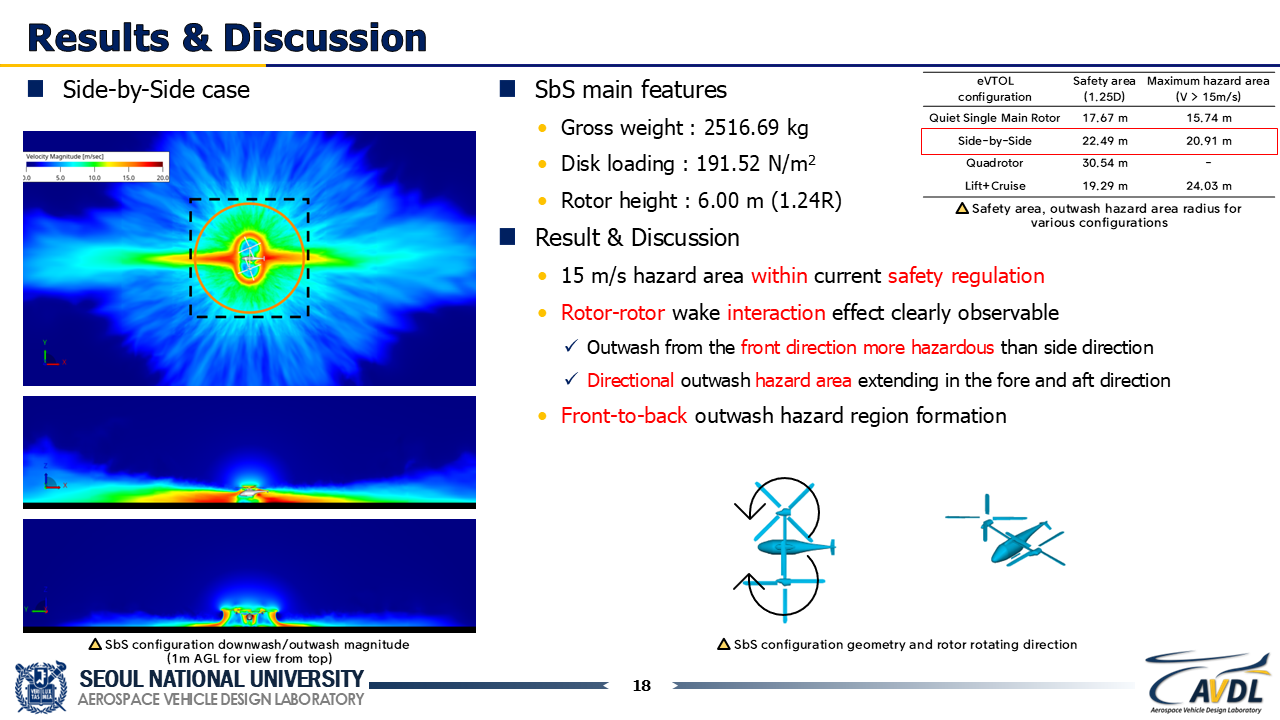
- Side-by-Side: Strong rotor–rotor interaction generated directional front-to-back outwash jets.
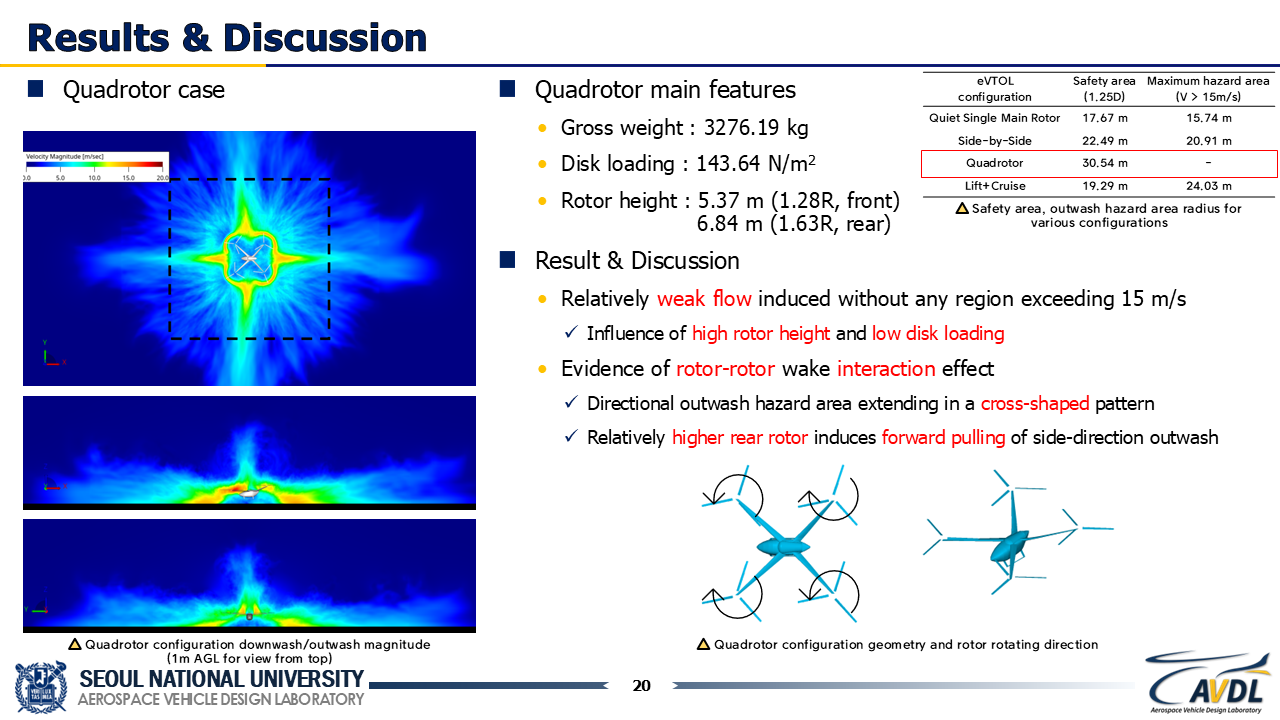
- Quadrotor: High rotor height and low disk loading prevented any region from exceeding the 15 m/s hazard threshold.
- Lift+Cruise (LPC): Extremely high disk loading led to hazard areas exceeding current safety regulation limits.
External Wind Effects (Lift+Cruise Case)
- 5 m/s wind expanded hazard areas by up to 30%.
- 10 m/s forward wind increased the hazard radius to 63.6 m, approximately 3× the current safety area regulation.
- Hazard expansion followed the order: Forward > Diagonal > Side wind.
These results indicate that even moderate wind conditions far below the 25 m/s operational limit can critically amplify ground-level outwash hazards.
🧭 Research Implications
This study highlights several open regulatory and technical questions:
- How should diverse eVTOL configurations be treated consistently in safety assessment?
- Which representative velocity metric should be used? (Time-averaged, RMS, 95th percentile, or absolute maximum?)
- Can existing military-based hazard models be applied to civilian UAM operations?
The findings suggest that current vertiport regulations may require configuration-aware and wind-sensitive updates.
🛠️ Key Technical Contributions
- Established a validated LBM-based workflow for rotorcraft downwash/outwash prediction.
- Demonstrated configuration-dependent hazard footprint variation across NASA UAM reference vehicles.
- Quantified wind-induced amplification of ground-level outwash, showing up to 3× safety-area exceedance.
- Provided physics-based insights into the influence of disk loading, rotor height, and rotor–rotor interaction.
👤 My Contributions
Although this work was conducted as a collaborative research project, my primary technical contributions focused on high-fidelity LBM validation and rotorcraft outwash prediction.
- Performed Lattice-Boltzmann solver validation against canonical aerodynamic benchmark cases (ONERA M6, ROBIN fuselage, Caradonna-Tung rotor).
- Conducted CH-47D tandem rotor downwash/outwash validation:
- Simulated 150 rotor revolutions with final 50-rev time averaging.
- Compared ground-level velocity profiles with experimental survey data and RANS/RANS-ALM results.
- Executed Joby S4 eVTOL geometry-based validation simulations, verifying wake structure and near-ground velocity distribution behavior.
- Analyzed velocity-field data to assess hazard threshold exceedance (15 m/s DCA criterion).
My role centered on establishing solver credibility and ensuring the physical reliability of the downwash/outwash prediction framework.
📚 Publications
- Juneyoung Lim, Seunghyun Joo, Kwanjung Yee. (2025). “Downwash/Outwash Analysis of eVTOL Configurations Using the Lattice-Boltzmann Method,” APISAT 2025.