
pyhyp-rotor-overset-generator: Open-Source Overset Mesh Generation for Rotors


🔍 Project Overview
Open-source toolchain that turns a plain-text per-section planform table (r/R, chord, twist about 0.25c, LE position, airfoil) into a complete overset (chimera) mesh system for rotor CFD:
- Blade component mesh — a watertight structured surface marched into a wall-resolved (y+ ≈ 1) hexahedral boundary layer with pyHyp (typical mean non-orthogonality ~2°)
- Full rotor — automatic replication of the blade volume about the rotor axis (
nBlades) - Background mesh — structured Cartesian grid with a rotor refinement box (spacing given in tip chords), growing geometrically outward
- Output is plain PLOT3D (+ ParaView VTK export), so the meshes are solver-agnostic.
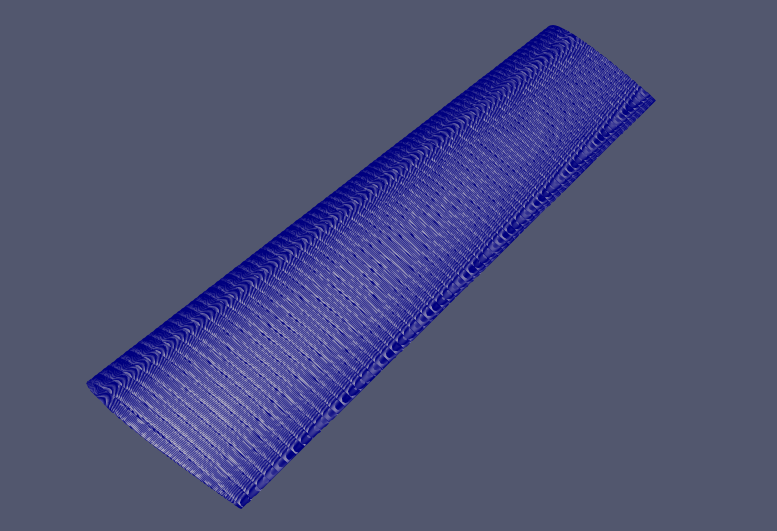
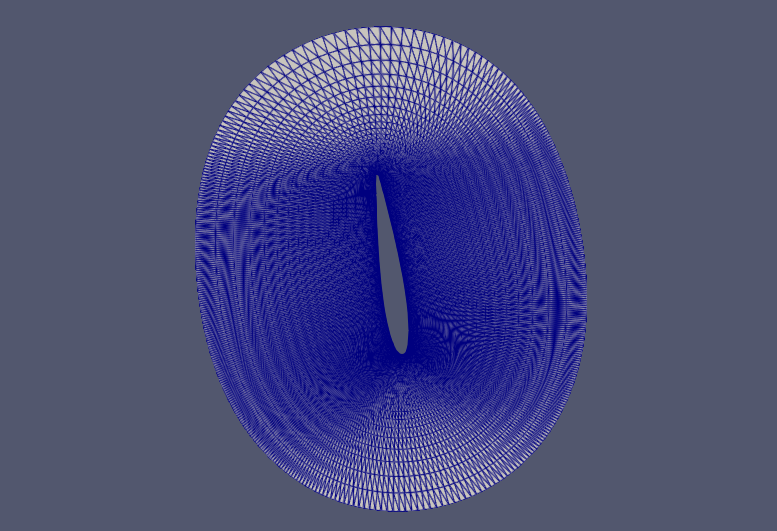
⚙️ Key Features
Non-degenerate watertight tip-cap topology
pyHyp’s normal-consistency check rejects any collapsed cap edge, so blade tips are closed with Coons-TFI caps whose four edges are exact point subsets of the blade perimeter (leading-edge nose arc / surfaces / blunt-TE seal) — the marcher sees only supported node topologies. Optional capDome rounds the tip cap.
Robust real-airfoil support
Selig and Lednicer coordinate files (e.g. straight from the UIUC database) are auto-detected, resampled with a cubic spline in √x space and noise-filtered, with the leading-edge point spacing automatically scaled to the estimated nose radius.
Overset-aware spacing control
autoMatch solves the geometric-series design problem so the outermost wall-normal blade cell lands just below the background refinement spacing — the classic overset donor-quality rule — validated against marched volumes to within ~2%.
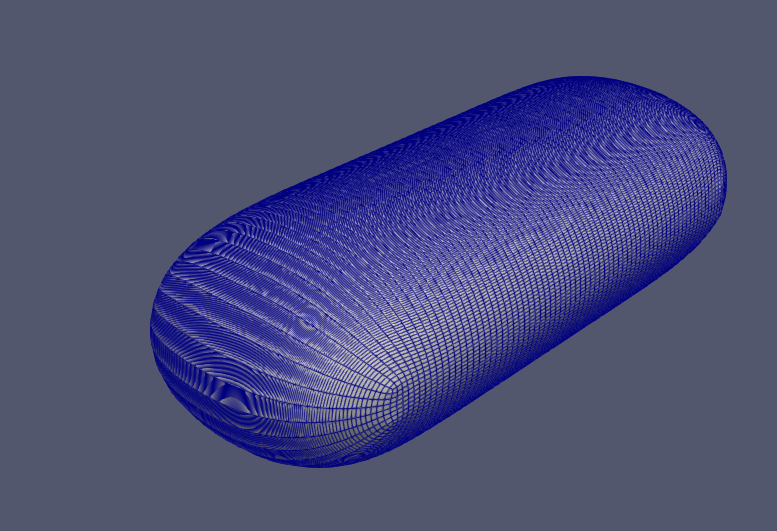
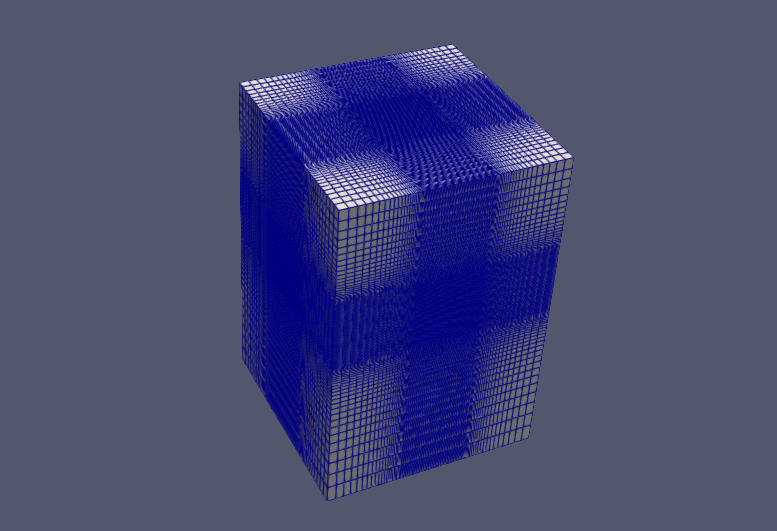
📦 Examples & Validation
Four fully-worked examples ship with the repository — the Caradonna–Tung hover rotor, a tapered/swept blade with an airfoil transition, a NACA 23012 blade, and a UH-60-style blade using the real Sikorsky SC1095 section — all marching to completion with final pyHyp Min Quality ≈ 0.42.
🔗 Links
- GitHub: SEUNGHYUN-JOO/pyhyp-rotor-overset-generator
- DOI: 10.5281/zenodo.21257648 — please cite when used
- License: MIT